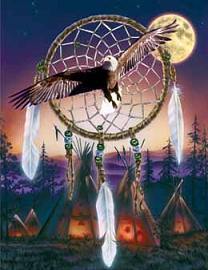
Dromenvangers worden door veel natuurvolkeren gemaakt. De Aboriginals en de Indianen staan bekend om hun dromenvangers. Het doel van de dromenvanger is overal gelijk. De genoemde volkeren gaan er van uit dat de hemel doorweekt is met dromen, goede dromen, maar ook slechte dromen. Als je in slaap valt, is er dus een kans aanwezig dat je een slechte of boze droom opvangt en die gaat beleven in je droomtijd. Een dromenvanger brengt daarin verandering. De dromenvanger wordt boven je slaapplaats gehangen en vangt de dromen op. Slechte of boze dromen worden door het web gevangen en vastgehouden, deze spatten uitéén bij het eerste ochtendlicht. De goede dromen, worden gevangen en vallen via het web en de veertjes op de ontvanger. Zodoende droomt deze persoon rustiger en vaak prettiger. Dromenvangers worden door de Indianen en Aboriginals vaak cadeau gegeven aan pasgeborenen. Op die manier begint een baby prettiger aan zijn leven hier op aarde. Een leuk idee is om persoonlijke voorwerpen in een dromenvanger te verwerken, bijv. een melktandje, een halfedelsteentje, een sieraad, kraaltjes etc. Zo kan een dromenvanger helemaal aangepast worden aan je eigen wensen. Indianen denken dat dromen ook voorspellend zijn; men maakt a.h.w. contact met levensgeesten, die een advies geven wat opgevolgd zou moeten worden. Zo ontstond de Indiaanse droomvanger. Het geloof van de dromenvanger en de intensiteit hiervan varieert tussen de verschillende stammen, echter het basis geloof is hetzelfde. Kleine dromenvangers werden vaak aan kinderen gegeven om boven hun bedje te hangen. Maar ook bij volwassenen was het gebruik hiervan heel gewoon. De dromenvangers werden traditioneel van wilg gemaakt en gevormd tot een cirkel. Het web dat geweven is tussen de wilg is gemaakt van pees en wordt aangekleed met veertjes, stenen en kralen, allen met hun specifieke betekenis. Andere tekens of attributen werden toegevoegd als er wensen waren voor speciale dromen of als medicijn en bescherming.
Veren: om dromen uit te laten komen en te geleiden.
Medicijn zakjes: als bescherming.
Stenen: naargelang de steen o.a. geestelijke kracht, genezing, slapeloosheid, lichamelijke kracht, spirituele beleving, rusteloosheid.
Bont: voor warmte en comfort.
De goede, vaak onderwijzende droom, welke zijn weg weet te vinden, wordt in het web doorgelaten en glijdt langzaam langs de veer naar beneden naar de dromer zonder deze te storen in zijn slaap.
De slechte dromen worden in het web gevangen en zullen, bij het opkomen van het eerste zonlicht, net als dauw uit het web verdreven worden.
Plaats de dromenvanger boven de slaapplaats en plaats het zo dat het eerste zonlicht het web raakt, wetende dat je dromen waarheid kunnen worden.

Dreamcatchers are made by many primitive peoples. The Aborigines and the Indians are known for their dream catchers. The purpose of the dream catcher is the same everywhere. The said people assume that the sky is soaked with dreams, good dreams, but also bad dreams. If you fall asleep, there is a chance that you or a bad nightmare that captures and will experience in your dream time. A dream catcher will change it. The dream catcher is hung above your bed and catches the dreams. Poor or bad dreams are caught and held the web, they burst out at first light. The good dreams are caught and are using the web and the feathers on the receiver. So these dreams often calmer and happier person. Dreamcatchers by the Indians and Aborigines often gifts given to newborns. Thus begins a baby more comfortable with his life here on earth. A nice idea is to personal items in a dream catcher to handle, eg a milk tooth, half precious stone, a jewel, beads etc. Thus, a dream catcher completely adapted to your needs. Indians believe that dreams are predictive, they were, makes contact with spirits, who give an opinion which should be followed. Thus arose the Indian dream catcher. The faith of the dream catcher and the intensity of this varies between the different tribes, but the same basic faith. Small dream catchers were often given to children to hang above their bed. But its use in adults were common. The dream catchers were traditionally made of willow and formed into a circle. The web that is woven between the tendon is made of willow and decorated with feathers, stones and beads, all with their specific meaning. Other signs or attributes were added when there were special needs or dreams as medicine and protection.
Springs: for dreams to come and guide.
Medicine bags: as protection.
Stone: stone such as the spiritual power, healing, insomnia, physical strength, spiritual experience, restlessness.
Fur: for warmth and comfort.
The good, often teaching dream, which knows its way to find the web is passed through and slowly slides along the spring down to the dreamer without disturbing his sleep.
The bad dreams are caught in the web and will, to the emergence of the first sunlight, like dew from the web to be expelled.
Place the dream catcher above the bed and place it so that the first sunlight hits the web, knowing that your dreams can be true.
Dreamcatchers son realizados por muchos pueblos primitivos. Los aborígenes y los indios son conocidos por sus captores de sueño. El propósito del atrapasueños es el mismo en todas partes. El dijo que la gente asume que el cielo está empapado de los sueños, sueños buenos, pero también los malos sueños. Si te quedas dormido, hay una posibilidad de que usted o una pesadilla que captura y experiencia en su tiempo de sueño. Un atrapasueños va a cambiar. El atrapasueños se cuelga encima de su cama y las capturas de los sueños. Pobres o los malos sueños son capturados y mantenidos en la web, que estalló en el primer semáforo. Los buenos sueños son capturados y están utilizando la web y las plumas en el receptor. Persona para que estos sueños a menudo más tranquilo y más feliz. Dreamcatchers por los indios y los aborígenes a menudo regalos a los recién nacidos. Así comienza un bebé más cómodo con su vida aquí en la tierra. Una buena idea es que los objetos personales en un atrapasueños de manejar, por ejemplo, un diente de leche, la mitad de la piedra preciosa, una joya, cuentas, etc Por lo tanto, un receptor de sueño completamente adaptado a sus necesidades. Los indios creen que los sueños son proféticos, que eran, hace contacto con los espíritus, que dan una opinión que deben ser seguidas. Así surgió el atrapasueños indio. La fe de los atrapasueños y la intensidad de éste varía entre las diferentes tribus, pero la fe misma base. Atrapasueños pequeños a menudo se da a los niños para colgar encima de su cama. Pero su uso en adultos eran comunes. El atrapasueños eran tradicionalmente hechas de sauce y formado en un círculo. La red que se teje entre el tendón se hace de sauce y decoradas con plumas, piedras y perlas, todas con su significado específico. Otros signos o atributos se agregan cuando había necesidades especiales o los sueños como la medicina y la protección.
Springs: para los sueños para venir y guía.
Bolsas de Medicina: como protección.
La piedra: piedra, como el poder espiritual, la curación, el insomnio, la fuerza física, la experiencia espiritual, la inquietud.
Fur: para el calor y comodidad.
El bien, a menudo la enseñanza de sueño, que conoce el camino para encontrar en la web se pasa a través y se desliza lentamente a lo largo de la primavera hasta el soñador sin perturbar su sueño.
Los malos sueños son capturados en la red y, a la aparición de la luz del sol en primer lugar, como el rocío de la web para ser expulsado.
Coloque el receptor de sueño por encima de la cama y el lugar para que la luz del sol golpea primero en la web, sabiendo que sus sueños pueden ser verdad.
Get your own Web Database - for FREE!